What Poseidon learned from injecting 3,500 tonnes of CO₂
Share this page
A real-world injection test in the UK's largest legacy gas field is providing new evidence on how existing offshore infrastructure could be reused for commercial CO₂ storage.
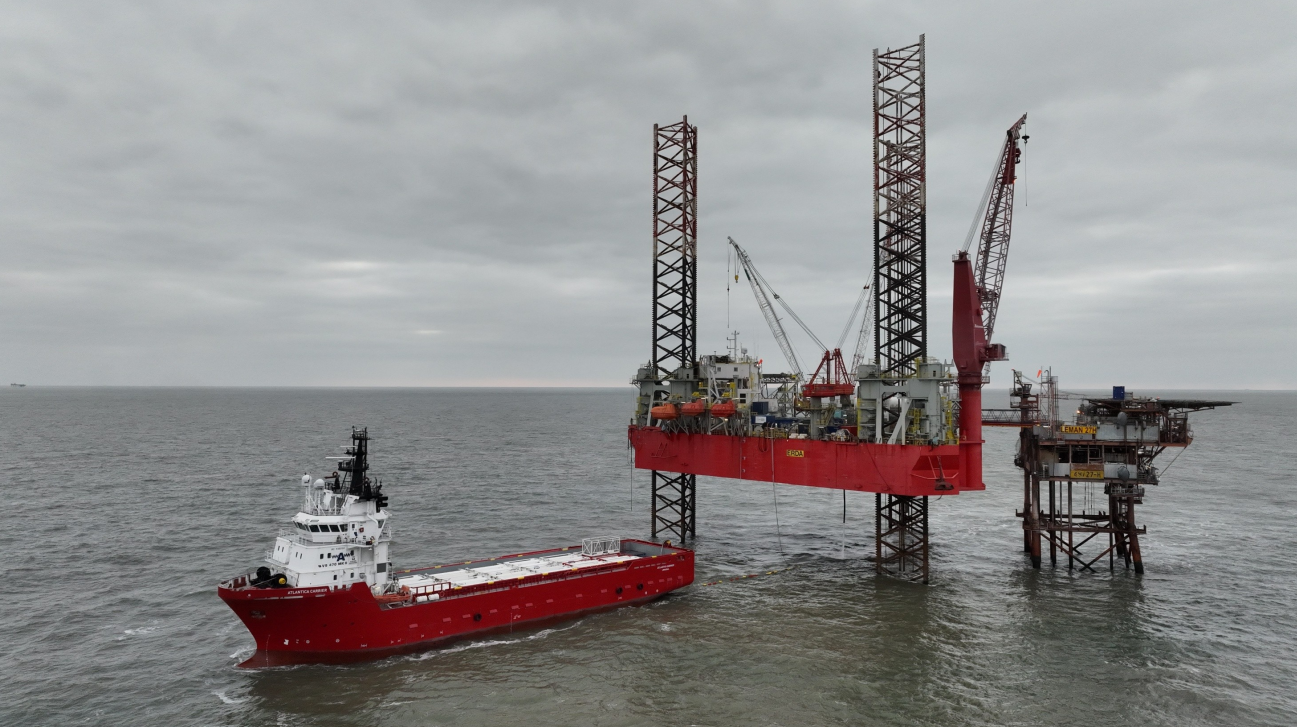
Offshore CO₂ transfer operations at the Poseidon CCS injection test site. Petrodec’s ERDA mobile jack-up platform (centre) is positioned alongside the existing Leman Hotel wellhead platform (right).
At its peak in the late 1970s, the Leman gas field supplied around 42% of UK gas demand.
Almost six decades after production began, Project Poseidon is looking at giving the field a very different role: storing CO₂.
The depleted gas field in the Southern North Sea has an estimated storage capacity of around 840 million tonnes of CO₂, as well as 15 platforms and around 200 wells. Some of that infrastructure could potentially be reused rather than replaced.
But before building a commercial storage project around existing infrastructure, you need to know how it actually behaves when you inject CO₂ into it.
That was the subject of an EERA JP CCS webinar with Nick Terrell, co-founder and Director of Carbon Catalyst, who presented results from Poseidon's offshore CO₂ injection test.
Putting CO₂ into the reservoir
Could an existing gas production well be converted for CO₂ injection? Could it handle commercial injection rates? How would the CO₂ behave in the well and reservoir? And could existing and new monitoring technologies provide the data needed to operate the store safely?
Over 43 days, the project completed ten offshore liquid CO₂ transfers and 15 injection cycles. Around 3,500 tonnes of CO₂ were injected into the reservoir.
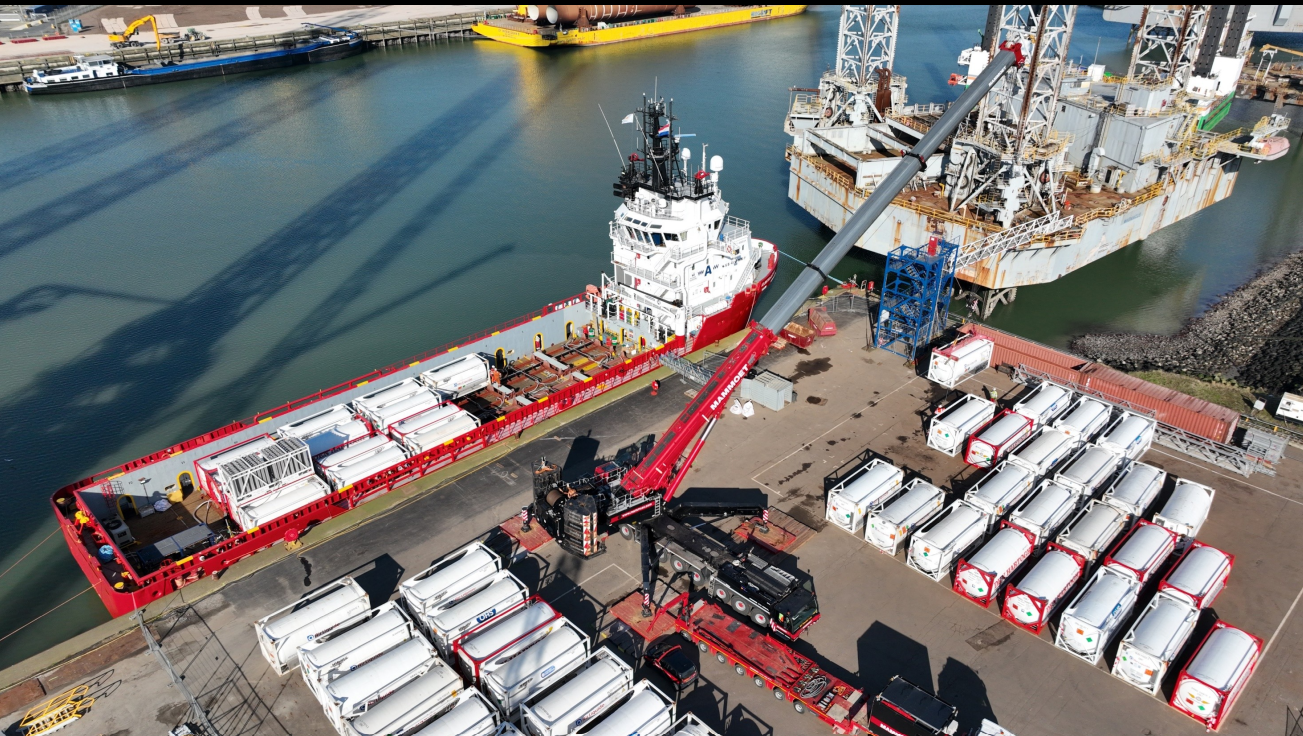
Loading of cryogenic liquid CO₂ ISO tanks onto the supply vessel at Dixtone’s shipyard in Vlissingen, the Netherlands, ahead of transportation to the UK Poseidon CCS offshore injection test site.
The team monitored the operation from the surface down to the reservoir using fibre optics, downhole pressure and temperature gauges, seismic methods and passive seismic monitoring.
The result was a dataset based on what actually happened underground, rather than modelling alone.
More than one million tonnes per year from one well
The test achieved stable injection equivalent to around 1.1 million tonnes of CO₂ per year from a single well. According to Carbon Catalyst, the test rate was limited by the agreed safety case rather than the reservoir, and the data suggests that higher rates could be possible.
For the future Poseidon development, Carbon Catalyst now considers more than 1 Mtpa per well a solid assumption, with rates of up to 2 Mtpa expected to be possible.
That could reduce the number of wells and amount of new offshore infrastructure needed for a commercial storage project.
Multiphase injection worked
During the 15 injection cycles, the team deliberately tested CO₂ under different conditions, including gas, supercritical and liquid phases.
The project saw no problems with multiphase injection in the Leman reservoir. Flow and pressure remained stable both at the surface and downhole.
Before the test, there had been concern that maintaining more tightly controlled liquid-phase injection might be necessary. For Poseidon, the results showed no clear advantage.
This opens the possibility of operating with lower wellhead pressures and temperatures, reducing the need for offshore heating and other equipment. Carbon Catalyst estimates that this could mean lower CAPEX, OPEX and power consumption, as well as lower emissions from operating the storage system itself.
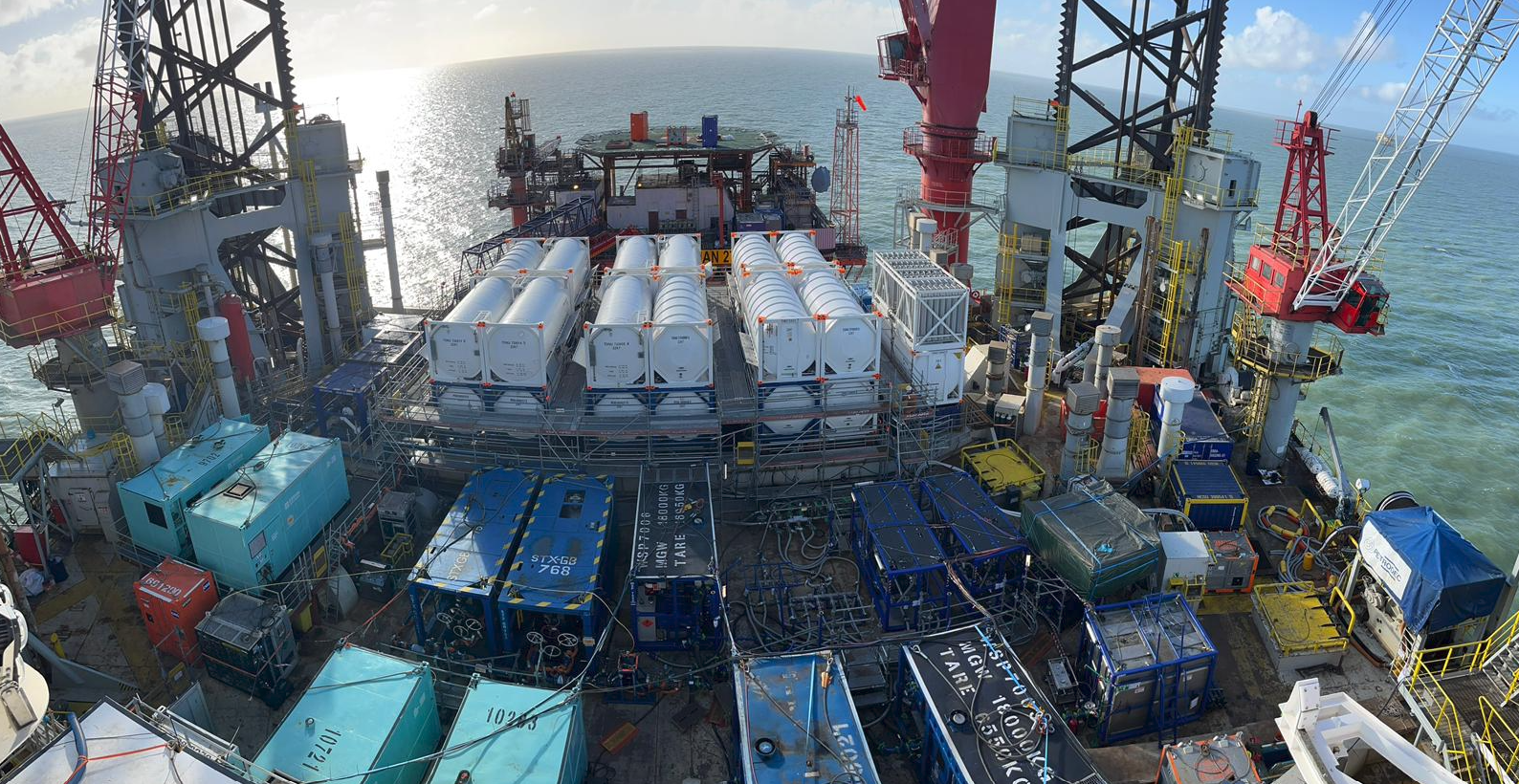
The 400-tonne liquid CO₂ tank farm (white tanks) and injection package installed aboard the ERDA mobile jack-up platform, with the existing Leman Hotel wellhead platform visible in the background.
How cold can you go?
At the highest injection rates, well temperatures reached as low as -12.5°C. Frequent start-stop cycles were used to test reservoir cooling under demanding conditions.
Even then, the lowest average temperature in the injection interval was around +13°C, above hydrate appearance temperatures.
The cooling was less pronounced than some of the project's more conservative models had predicted.
Terrell was careful not to generalise the result to every storage site. Different reservoirs, wells and operating conditions will behave differently. But that is also why field data from projects such as Poseidon is useful.
Reusing more than wells and platforms
The test also provided data for Poseidon's future Monitoring, Measurement and Verification programme.
Existing wells across the field could potentially be converted into monitoring wells, with fibre optics and other equipment installed to track pressure, temperature and CO₂ behaviour.
The idea of repurposing therefore goes beyond simply using an old platform or injection well. Parts of the existing field infrastructure could continue to have a role in demonstrating that the storage site is behaving as expected and in a cost-effective manner.
Poseidon's first planned development phase is relatively modest, ramping up from one million to three million tonnes of CO₂ per year, delivered by ship and injected through converted wells on an existing platform.
Its location puts Poseidon within reach of industrial regions in the UK and continental Europe. Later phases could bring in CO₂ from more emitters by ship and eventually by pipeline, with the project targeting a possible peak injection rate of around 40 million tonnes per year.
Whether that happens will depend on more than geology. Cross-border rules, transport infrastructure, commercial models and coordination between countries will all play a part.
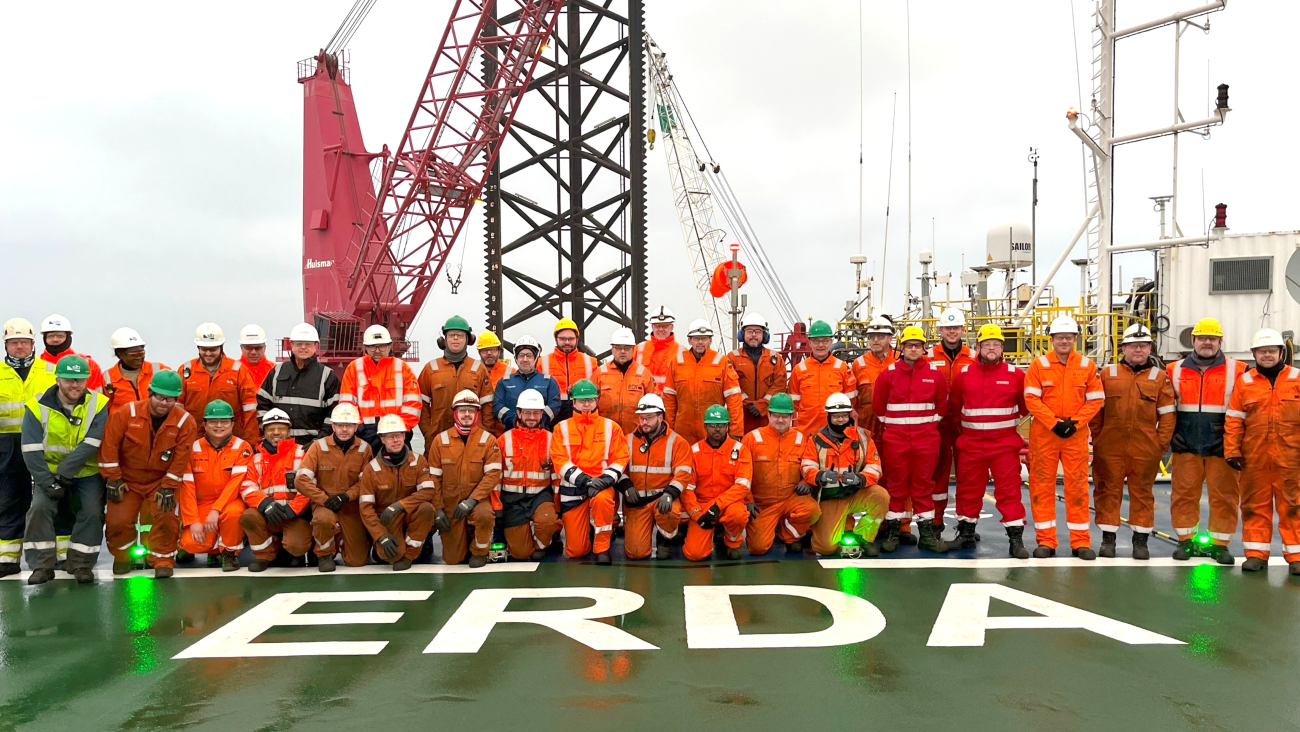
Members of the Perenco, Petrodec and contractor teams involved in the offshore CO₂ injection test aboard the ERDA mobile jack-up platform.
Why share the results?
Terrell began the webinar by explaining that the Poseidon joint-venture wants to share data from the test because there is still relatively little empirical information available from commercial-scale CCS operations.
For EERA JP CCS, this is also where collaboration between research and industry becomes important. Real project data can help researchers improve models, identify remaining knowledge gaps and test whether assumptions developed in the laboratory hold up offshore.
What the sector can learn from those 3,500 tonnes may be the more important result.
Offshore CO₂ transfer operations at the Poseidon CCS injection test site. Petrodec’s ERDA mobile jack-up platform (centre) is positioned alongside the existing Leman Hotel wellhead platform (right).
Login as an EERA member
In case you are an EERA member and don’t have login details, please contact a.schneider@eera-set.eu
 Offshore CO₂ transfer operations at the Poseidon CCS injection test site. Petrodec’s ERDA mobile jack-up platform (centre) is positioned alongside the existing Leman Hotel wellhead platform (right).